
From Scissors to Software: The Evolution of Silicone Gasket Cutting
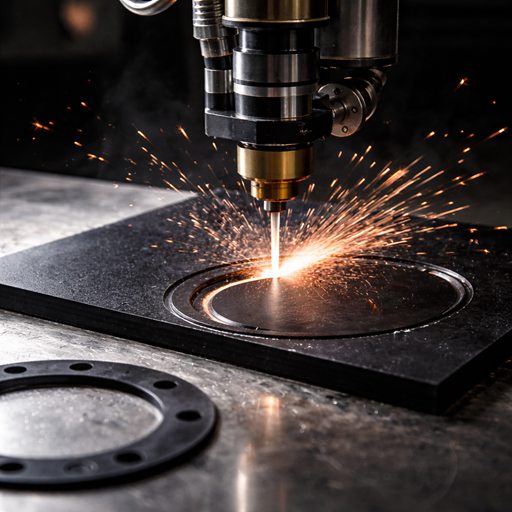
Silicone gaskets are everywhere. They seal the engine in your car, the pump in your dishwasher, the enclosure on a subsea sensor, and the medical device keeping someone alive in a hospital bed. They look simple — a flat piece of rubbery material with some holes in it. But anyone who has spent time cutting them knows the truth: silicone is one of the most demanding materials in the gasket world, and the industry's journey toward cutting it well has been long, expensive, and hard-won.
At Advanced Technology Supply, Inc. (ATS), we've been navigating that journey for nearly 40 years. Based in Deerfield Beach, Florida, ATS has grown into an award-winning leader in the converting and fabricating industry — and silicone gasket manufacturing sits at the heart of what we do. The evolution described in this post isn't abstract history to us; it's the story of how our craft developed, and why the expertise we've built matters to every customer who sends us a drawing.
The Early Days: Hand-Cutting and the Brute-Force Era
Before dedicated tooling existed, silicone gaskets were cut by hand. A fabricator would lay a sheet of silicone stock on a flat surface, press a paper or cardboard template down, and trace it with a sharp knife — often a utility blade or a bespoke hand punch. For simple shapes and low volumes, this worked well enough. For anything complex, it was a nightmare.
The core problem is silicone's physical nature. Unlike rubber compounds or cork-based materials, silicone has almost no internal damping. It stretches under cutting pressure, springs back when released, and loves to stick to itself, to tooling, and to work surfaces. A hand-cut gasket would frequently be slightly undersized in one direction and oversized in another, simply because the material moved while the knife was moving through it.
Bolt holes were punched separately with hollow-core punches driven by a mallet. This introduced its own hazards: torn edges, elliptical holes where the punch rocked, and surface tears from the punch sticking to the silicone on withdrawal.
Quality was inconsistent. Scrap rates were high. And skilled hand-cutters became genuinely valuable — their feel for how hard to push, how fast to draw, and how to keep the sheet from crawling was institutional knowledge that walked out the door when they retired.
Steel Rule Dies: The First Industrial Step Forward
The next major evolution was the die-cutting press using steel rule dies (also called steel rule tooling or clicker dies). A custom die — essentially a sharpened steel blade bent into the profile of the gasket and embedded in a wooden backer — was pressed down through the silicone sheet using a hydraulic or mechanical clicker press.
This was transformative for medium-volume production. Repeatability improved enormously, and complex profiles could be reproduced accurately once a good die was made. Die-cutting is still widely used today and remains the method of choice for many high-volume applications where the die cost is amortized across thousands of parts. ATS operates steel rule die cutting in-house precisely because of this — for the right application and volume, it remains one of the most cost-effective paths to a finished silicone gasket.
But silicone exposed the limits of steel rule dies quickly:
Edge quality degradation. Silicone is abrasive enough to dull steel rule tooling faster than most gasket materials. A die that would cut thousands of cork or compressed fiber gaskets cleanly might begin tearing silicone edges after a few hundred cuts, requiring regrinding or replacement.
Compression distortion. The clamping pressure required to hold the sheet flat during the cut can compress softer silicone durometers, leaving the cut edge slightly tapered or the finished part slightly thinner at the perimeter than at the center.
Sticking. Silicone's high surface energy means it bonds enthusiastically to the die. Without release agents — typically a silicone-safe mold release spray or PTFE coating on the die faces — parts would lift with the die on retraction, tearing edges or distorting the part.
Minimum feature size. Inner profiles, narrow webs between bolt holes, and tight radii pushed the practical limits of what steel rule tooling could achieve without the rule collapsing or the silicone tearing rather than cutting cleanly.
Punch Presses and Progressive Tooling
For high-volume, simple-profile gaskets, dedicated punch-and-die sets in hydraulic or pneumatic presses offered better control than clicker dies. The closed die system — with a precisely matched punch and die ring — produced cleaner edges and tighter tolerances on hole diameters.
Progressive tooling took this further, combining multiple operations (outer profile, bolt holes, inner bores) in a single press stroke using a multi-station die. A roll of silicone sheet would feed through the press, and finished gaskets would emerge at the other end, partially or fully cut free.
The pitfalls here centered on material feed consistency and durometer sensitivity:
- Silicone sheet has significant variation in thickness within a roll, and this affects cut quality. Tooling set for 3.0 mm stock that encounters a 2.7 mm section may leave a connected "flash" of uncut material; at 3.3 mm it may bottom out and begin compressing rather than cutting.
- Softer durometers (Shore A 30–50) behave almost like a gel under rapid punch loading. They deform ahead of the cutting edge, leading to ragged entry wounds and false starts on inner features.
The Water Jet Era: Cold Cutting Comes of Age
The arrival of abrasive and pure water jet cutting in fabrication shops during the 1980s and 1990s opened a new chapter for gasket cutting. A pure water jet — no abrasive — turned out to be exceptionally well suited to silicone. It's one of the reasons ATS invested in water jet cutting capability and continues to rely on it for complex, precision silicone gasket profiles today.
Water jet cutting offered several genuine advantages:
No heat. Silicone can be cut thermally, but heat introduces stress and can alter the cured material properties near the cut edge. Water jet cutting is entirely cold, preserving material integrity right to the edge.
No tool wear. There is no blade to dull, no die to regrind. The same cutting quality on part one is available on part ten thousand.
Complex geometry. A CNC water jet table can cut any profile that can be described in a CAD file, including internal features, complex curves, and very small radii, all in a single setup.
Thin-web capability. Features that would collapse a steel rule die — 2 mm webs between adjacent bolt holes, for example — are cut without mechanical force and without risk of the intermediate material tearing free.
The pitfalls in water jet cutting of silicone are real but manageable:
Surface adhesion. Silicone on a flat table will migrate under the water jet's impact pressure. Sheets must be fixtured carefully — vacuum fixturing or water-submersion cutting (where the entire sheet is submerged and weighted) both work well. Double-sided tape to a sacrificial backer is another common approach.
Edge frosting. At high feed rates, the water jet can leave a slightly roughened, translucent edge on silicone rather than a clean cut. Reducing feed rate and optimizing standoff distance (the gap between the nozzle and the work surface) corrects this.
Delamination on multi-durometer composites. Silicone gaskets are sometimes laminated — a softer face layer bonded to a harder substrate, or a silicone layer bonded to a metal carrier. The water jet can delaminate these composites at the edge. This is largely a design issue (adequate bond strength between layers) but also requires cutting parameter adjustment.
Part flotation. Once an inner feature (like a bolt hole slug) is cut free, it can be swept by the water stream and become a projectile or jam under the nozzle. Appropriate screen catching systems or submersion cutting mitigates this.
Laser Cutting: Promise and Peril
CO₂ laser cutting became broadly accessible to fabricators through the 1990s and 2000s, and many shops experimented with it on silicone. The results were mixed enough that laser cutting of silicone remains a specialized application rather than a universal solution.
Where lasers work: High-power CO₂ lasers can cut silicone cleanly at high speed, and for thin sheets (under 3 mm) the edge quality can be excellent. Fiber lasers are generally unsuitable for silicone because silicone is largely transparent to near-infrared wavelengths.
The combustion problem: Silicone burns rather than melts cleanly. The cut edge on laser-cut silicone is typically carbonized — visually darkened and sometimes structurally altered in a thin zone adjacent to the cut. For most industrial sealing applications this is cosmetically undesirable and may affect long-term sealing performance. For food-grade or pharmaceutical applications, carbonized edges are simply unacceptable.
Outgassing: Burning silicone releases silicone dioxide particulate and other combustion products. Laser cutting silicone requires very aggressive fume extraction and filtration, and many CO₂ laser systems need dedicated filtration media to handle silicone combustion products without clogging standard HEPA filters.
Thickness limits: Beyond about 6 mm, CO₂ laser cutting of silicone becomes impractical due to carbonization depth and the tendency for the cut kerf to close behind the beam on thicker sections.
For these reasons, laser cutting of silicone is most appropriate for very thin decorative or low-durometer applications where carbonization is acceptable and edge sealing performance is not critical.
Digital Knife Cutting: The Modern Standard
The most significant recent evolution in silicone gasket cutting has been the rise of high-speed digital knife cutting systems — CNC flatbed cutters equipped with oscillating or drag knife heads. These systems combine the geometric flexibility of water jet and laser cutting with the clean, cold, no-waste cutting action of a physical blade.
Modern digital knife systems use:
Oscillating blades that reciprocate at high frequency (often 18,000–40,000 strokes per minute), effectively "sawing" through the material rather than dragging. This dramatically reduces the lateral force on the material, allowing thin webs and small features to be cut without displacement.
Vacuum conveyor beds that hold the silicone sheet flat against the surface through suction, eliminating the migration problem that plagued earlier methods.
Automatic tool compensation that adjusts blade angle and depth based on material sensor feedback, accommodating sheet thickness variation within a roll.
Nesting software that optimizes part layout to minimize scrap — critical when working with specialty high-purity or fluorosilicone sheet stock that may cost many dollars per square inch.
The pitfalls in digital knife cutting center on blade management and parameter discipline:
- Silicone dulls blades faster than most other gasket materials. A blade that cuts 50 meters of compressed fiber without degradation may begin tearing rather than cutting silicone after 10 meters. Blade change schedules must be established empirically for each material.
- Too much oscillation frequency for a given durometer can cause the silicone to heat locally, causing the blade to stick and drag. Too little frequency on a harder durometer leaves a ragged edge. Getting this right requires methodical parameter development.
- On softer materials, the vacuum bed can indent the silicone, causing the cut depth to vary across the sheet. Sacrificial backer material between the silicone and the vacuum surface resolves this.
Specialized Methods Worth Knowing
Cryogenic cutting — cooling the silicone sheet to well below zero before cutting — is used in specialized applications. Cold silicone loses its elastic character temporarily and behaves more like a rigid thermoplastic, cutting cleanly with conventional tooling. The technique is niche but genuinely effective for very soft durometers or complex profiles in materials that are otherwise nearly impossible to cut cleanly at room temperature.
Flash cutting / die-cutting on FEP release film — placing the silicone sheet on a PTFE or FEP carrier film before die cutting — reduces sticking dramatically and can extend die life. The release film acts as a parting layer between the die and the silicone surface.
Waterjet-laser hybrid systems — emerging in advanced fabrication environments — combine a water jet nozzle and CO₂ laser head on the same gantry, allowing the operator to use water jet for full-thickness cuts and laser for shallow scoring or marking.
Universal Pitfalls Across All Methods
Regardless of cutting technology, certain failure modes appear again and again in silicone gasket fabrication:
Ignoring durometer in parameter selection. A Shore A 40 silicone and a Shore A 70 silicone are not interchangeable inputs to the same cutting recipe. Every change in material hardness requires a re-evaluation of speed, pressure, blade frequency, and fixturing.
Trusting the certificate without measuring. Silicone sheet stock thickness varies more than most gasket materials. A roll certified as 3.0 mm may run from 2.8 to 3.2 mm within the same roll. Measure before cutting, not after you have scrapped fifty parts.
Underestimating thermal sensitivity. Even methods that don't apply external heat can generate localized heat through friction. Silicone that gets warm becomes tackier, stickier, and more prone to tearing. Cutting speed, blade coating, and ambient shop temperature all matter.
Neglecting edge inspection. A clean silicone gasket edge should be smooth, perpendicular to the sheet face, and free of tears, frayed fibers, or rolled lips. Checking edge quality under low-power magnification before releasing a new setup to production catches problems that are invisible to the naked eye.
Assuming silicone is silicone. High-purity platinum-cure silicone, standard peroxide-cure silicone, fluorosilicone, self-adhesive silicone foam, and conductive silicone all cut differently and require different approaches. The base polymer name tells you almost nothing about how the finished sheet will behave under the knife.
Looking Ahead
The frontier in silicone gasket fabrication is increasingly the integration of in-process measurement with cutting. Vision systems that scan the sheet before cutting and adjust nesting to avoid thickness anomalies or surface defects are moving from aerospace-tier operations into general fabrication shops. AI-assisted parameter optimization — where the cutting system adjusts blade speed, frequency, and depth dynamically based on real-time force feedback — is beginning to appear in high-end digital knife systems.
Additive manufacturing (3D printing of silicone) is developing rapidly and will eventually displace cut gaskets in some applications, particularly complex three-dimensional seals that would require multiple cut and bonded pieces today. But for flat and near-flat applications, cut gasket technology is mature, highly capable, and unlikely to be displaced soon.
The evolution from a hand-held knife on a sheet of silicone to a software-driven, vacuum-fixtured, oscillating-blade CNC system reflects how much engineering effort the industry has invested in mastering a material that looks simple but demands respect. Get the parameters right, manage your tooling, and understand what your specific silicone formulation will and won't tolerate — and you'll produce gaskets that seal reliably for the life of the application. Cut corners, and the silicone will find a way to remind you why that's a bad idea.
Let ATS Handle It
Nearly four decades of experience in silicone gasket manufacturing means ATS has worked through every pitfall described in this post — and developed the processes, tooling, and material knowledge to avoid them consistently. Whether you need solid silicone gaskets, sponge silicone gaskets, or silicone foam gaskets, ATS can cut them to your exact design and specification using steel rule die cutting or water jet cutting, with or without adhesive backing for easy installation.
We stock and fabricate a wide range of elastomeric materials — including silicone rubber sheets, silicone sponge, and foam — and our capabilities extend well beyond gaskets: rotary die cutting, rewind slitting, single knife slitting, lamination services, belt fabrication, and rapid-turn prototyping are all available under one roof.
Need help with silicone gaskets?
Request a custom quote from ATS24